

The most unsettling part of a sideswipe accident is the question of fault. It’s rarely clear-cut. From your home, the actions you take in the next few days are fundamental to establishing what happened and ensuring you are treated fairly.
The process involves carefully documenting what you remember, understanding how New Hampshire’s specific laws apply, and communicating properly with insurance companies. Speeding, distracted driving, and unsafe lane changes are common causes of these crashes, and proving the other driver was negligent is the key to your claim.
If you have questions about your specific situation, the team at Coates Law Office is here to help. Call us at 619-323-3280
Key Takeaways for Sideswipe Accidents
- Fault determines compensation. The driver who left their lane is typically at fault, but New Hampshire’s comparative fault rule reduces your payment if you are found partially to blame.
- Immediate documentation is important. Preserve evidence by writing down everything you remember and photographing the scene, as this helps counter the “he said, she said” nature of these accidents.
- Let a professional handle the insurer. The other driver’s insurance adjuster will try to minimize their payout, so never give a recorded statement or accept a quick offer without legal advice.
Who Is Typically At Fault in a Sideswipe Collision in New Hampshire?

In most sideswipe cases, the driver who left their lane of travel is the one considered at fault. However, insurance companies will conduct a thorough investigation to see if you share any of the blame.
This is where the situation becomes difficult. The other driver might claim you drifted into their lane, were in their blind spot, or were speeding. Without clear evidence, the insurance adjuster might try to assign partial fault to you. This point is significant in New Hampshire, which follows a “modified comparative fault” rule.
Explaining Modified Comparative Fault
This legal rule, detailed in New Hampshire Revised Statutes section 507:7-d, means you are eligible for compensation as long as you are determined to be 50% or less at fault for the accident. If you are found to be 51% or more at fault, you are barred from recovering anything.
Any compensation you receive is reduced by your percentage of fault. Insurance adjusters understand this rule and will look for any reason to place a percentage of the blame on you to reduce their payout.
Our role is to build a strong case based on the facts to counter these arguments. We work to show precisely how the other driver’s actions—such as failing to signal, checking a blind spot, or drifting due to distraction—were the direct cause of the collision.
Common Scenarios Establishing Fault
- Unsafe Lane Change: A driver merges into your lane without ensuring it was clear.
- Failure to Yield: A driver entering a highway fails to yield to traffic already present.
- Overcorrecting: A driver swerves and overcorrects, entering the adjacent lane.
- Sideswipe While Turning: One car makes a wide turn, striking a vehicle in the next lane.
What Are My First Priorities Now That I’m Home?
Now that you are away from the scene, your focus shifts to two key areas: your health and your evidence. Even minor sideswipes jolt the body in unnatural ways, and injuries may not be immediately apparent.
Why a Medical Check-Up Is So Important
Always get a medical evaluation after any accident, even if you feel fine. Soft-tissue injuries like whiplash or even concussions have delayed symptoms. Pain might flare up days or even weeks later because the adrenaline from the crash masks initial pain. Seeking medical attention creates a formal record that links any potential injuries to the accident. Without this link, an insurance company may later argue your injuries are unrelated to the crash.
At the same time, you need to begin documenting everything related to the accident. The small details you gather now become the foundation of a successful claim.
- Write Down Everything You Remember: Do this now, while the memory is fresh. Where were you coming from and going to? What lane were you in? Did you see the other car before the impact? What did you hear? What did the other driver say?
- Organize Your Photos: If you took photos at the scene, save them in a dedicated folder. Look at the damage to both cars. The angle and location of the damage tells a story about how the impact occurred.
- Check for Additional Evidence: Think about the location. Were there any businesses nearby that might have security cameras? Was it an intersection with a traffic camera? A personal injury firm sends a spoliation letter to preserve this kind of video evidence before it’s erased.
Your Next Legal Requirement Is Reporting the Accident
In New Hampshire, you must file a written report with the DMV within 15 days if the accident caused an injury, death, or more than $1,000 in property damage—unless the police already filed a report at the scene. This requirement is outlined in New Hampshire Revised Statutes section 264:25. Given the high cost of modern car repairs, almost any sideswipe will exceed this threshold.
What If the Other Driver Didn’t Stop?
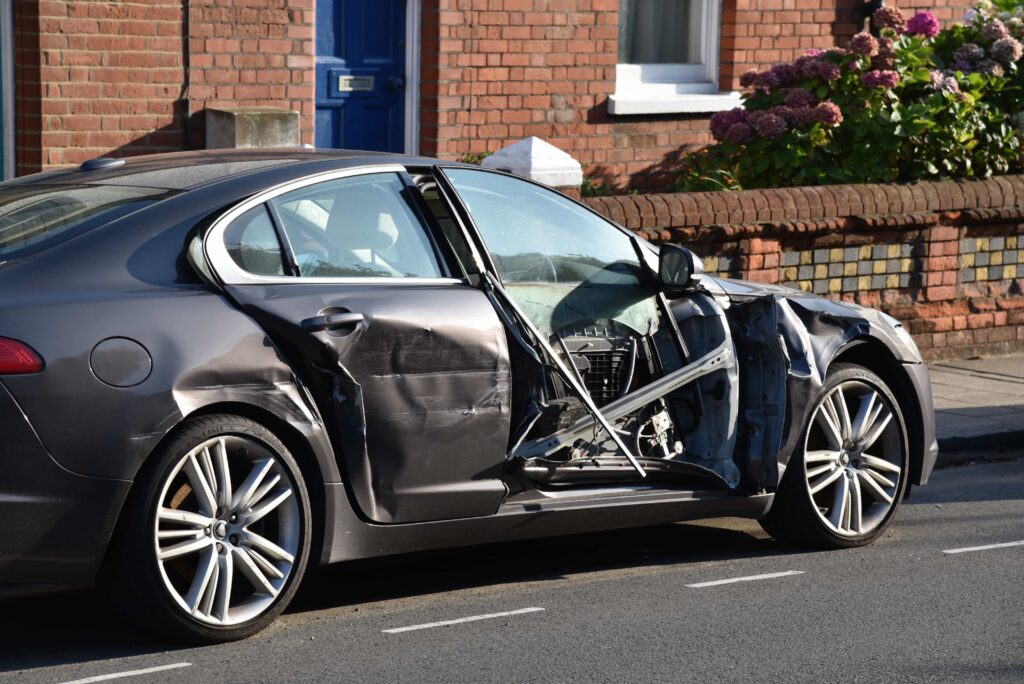
Step 1: Report It to the Police Immediately
Even if the damage looks minor, or you’re unsure whether the other driver meant to flee, you still need to report it.
In New Hampshire, you’re required to file a police report within 15 days if there’s injury, death, or over $1,000 in property damage (N.H. Rev. Stat. § 264:25). Most modern car repairs exceed that amount, even for a sideswipe.
Tell the dispatcher what happened and explain that the other driver left the scene. If you’re still at the location, they may send an officer. If not, they’ll direct you to file a report at the station or online. Don’t wait. A delay gives the other driver time to repair their vehicle and erase any evidence.
Step 2: Write Down Everything You Remember
When there’s no one to exchange info with, your memory becomes the first piece of evidence. Right now, before anything fades, write down:
- The time and location of the accident.
- Any details about the other car: make, model, color, bumper stickers, anything.
- What part of your car was hit, and how the impact happened.
- If you caught a partial plate number, even a few characters, note that.
- What direction they were headed—left, right, through a light.
Think of this as building a snapshot of the moment, not a perfect story. Small details help later, even if they don’t seem important now.
Step 3: Look for Witnesses and Cameras
Was anyone around who might’ve seen what happened? A pedestrian. A driver behind you. A business owner unlocking their door.
Ask nearby businesses if they have security footage. Some security systems loop over recordings in 24 to 72 hours. Your lawyer can send a formal request (called a spoliation letter) to preserve the footage before it’s erased.
Public intersections may also have traffic cameras. These can show exactly what happened, even if the other driver is long gone.
Step 4: Contact Your Own Insurance But Cautiously
In New Hampshire, drivers are not required to carry auto insurance. But if you do have a policy, it likely includes Uninsured Motorist (UM) coverage. This coverage steps in when the at-fault driver can’t be identified or doesn’t have insurance.
You’re technically making a claim against your own policy, but you still need to treat it seriously. Insurance companies will still ask for proof that the other driver caused the crash and fled the scene. Some may even question whether the hit-and-run happened at all.
To protect yourself:
- File the police report first. Your insurer will ask for it.
- Avoid giving written or recorded statements until you’ve spoken with a lawyer.
- Document all damage and injuries just as you would in a normal claim.
If you’re unsure how to explain it or don’t feel ready, tell them your car accident lawyer will follow up.
Step 5: Get Medical Care Immediately
As with any sideswipe, injuries might not show up right away. A jolt to the side of the car twists the body in ways that aren’t always obvious at first.
See a doctor as soon as you can, even if you “feel fine.” The exam creates a medical record linking the crash to your symptoms. That link is what your insurance company will look for when deciding whether to approve treatment costs.
What If You Never Find the Other Driver?
You can still recover compensation.
If you have UM coverage and meet the reporting and evidence requirements, your insurer may cover:
- Your medical bills
- Lost wages
- Pain and suffering
- Car repair or replacement
The process might take longer. And they may ask for more proof than usual. But it’s possible and we’ve handled many cases just like this.
How Should I Talk to the Insurance Companies?
You will soon receive a call from the other driver’s insurance adjuster. Their job is to gather information to determine fault and the value of your claim.
It’s easy to assume this will be a straightforward conversation, but it is filled with potential pitfalls. The adjuster is highly trained, and their goal is to protect their company’s financial interests. This means they will be listening for anything that might be used to argue you were partially at fault.
They may ask leading questions like, “You didn’t see the other car coming, did you?” or ask you to give a recorded statement before you’ve had time to think through all the facts. They might seem friendly and helpful, but they are not on your side. An innocent apology or an admission of uncertainty (“I’m not sure what happened”) is twisted and used against you later.
Knowing what to say, and what not to say, protects your claim.
- DO:
- Provide basic information: Confirm your name, address, and the type of car you drive.
- Stick to the facts: State simply that you were involved in an accident on a specific date at a specific location.
- Say, “I am still assessing the full extent of my injuries and property damage.” This prevents them from locking you into an early, incomplete assessment.
- Refer them to your attorney: The safest approach is to let a legal professional handle all communications. Simply say, “My attorney will be in contact with you.”
- DON’T:
- Do not agree to a recorded statement. You are not required to provide one.
- Do not speculate on fault or apologize.
- Do not downplay your injuries. Avoid saying “I’m fine” or “I’m okay.”
- Do not accept an immediate settlement offer. Early offers are almost always too low and do not account for future medical needs or the full cost of repairs.
What Compensation Is Available After a Sideswipe?
The purpose of a personal injury claim is to make you “whole” again, at least from a financial standpoint. This means pursuing compensation, known legally as “damages,” for all the losses you have suffered because of the accident. The value of your claim depends on the severity of your injuries and the total impact on your life. We work to identify and calculate all available damages to pursue the maximum compensation available under the law.
These damages typically fall into two main categories:
- Economic Damages: These are the direct financial losses with clear monetary values.
- Medical Bills: This includes everything from the initial emergency room visit and ambulance ride to future physical therapy, medications, and any necessary long-term care.
- Lost Wages: Compensation for the income you lost while unable to work. This also includes loss of future earning capacity if your injuries prevent you from returning to your previous job.
- Property Damage: The cost to repair or replace your vehicle and any other personal property damaged in the crash.
- Non-Economic Damages: These losses are intangible but just as real. They compensate you for the human cost of the accident.
- Pain and Suffering: This accounts for the physical pain and emotional distress caused by your injuries.
- Emotional Distress: Compensation for anxiety, depression, sleep loss, or other psychological impacts stemming from the traumatic event.
- Loss of Enjoyment of Life: If your injuries prevent you from participating in hobbies, activities, or daily routines you once enjoyed.
New Hampshire law has a strict three-year deadline, known as the statute of limitations, for filing a personal injury lawsuit. As codified in New Hampshire Revised Statutes section 508:4, if you miss this deadline, you lose your right to seek compensation in court forever.
Frequently Asked Questions About Sideswipe Accidents
What if the other driver has no insurance?
In this case, you may file a claim through your own insurance policy, provided you have Uninsured/Underinsured Motorist (UM/UIM) coverage. In New Hampshire, if you purchase auto insurance, you must also purchase Uninsured Motorist Coverage. We will review your policy to determine your options.
Will my insurance rates go up if I file a claim?
If the other driver is found to be at fault, your insurance rates should not increase. Filing a claim is your right, and you should not hesitate to use the coverage you pay for.
What if the police report seems wrong or places me at fault?
Police reports are important, but they are not the final word. An officer’s conclusion about fault is an opinion based on the evidence at the scene. We will conduct a more thorough investigation to uncover evidence that may paint a more accurate picture.
Do I really need an attorney for a “minor” sideswipe?
Even low-speed sideswipes cause hidden frame damage to your vehicle and delayed injuries. Having a law firm on your side ensures the insurance company takes your claim seriously and that you don’t accept a settlement that fails to cover your future costs.
Don’t Let Uncertainty Decide Your Future

You might be questioning what happened, who was at fault, and how you will manage the costs. You do not have to find these answers alone.
Let us provide the clarity and direction you need. At the Coates Law Office, our practice focuses on handling car accident claims. We will manage the investigation, deal with the insurance companies, and work to ensure you are positioned to receive the full compensation you are entitled to under New Hampshire law.
Your next step is a simple conversation. If you have questions about your sideswipe accident, call us for a straightforward evaluation of your case. Contact the Coates Law Office today at (619) 323-3280.